
How to Apply for a Spanish Student Visa, Step by Step
Most guides list documents. This one follows the actual journey — from the moment you decide to study in Spain to the day your course certificate lands in your inbox. Based on the process described by Spain's Ministry of Inclusion, Social Security and Migration, here is every phase explained in depth.
Key takeaways
- The process has seven phases, and three different parties play a role: you, your school, and the consulate.
- Your school does more than teach — it produces the documents your entire application depends on.
- The visa doesn't end at approval: the school keeps a role throughout your course, tracking attendance and issuing certificates.
- In specific cases, current regulations allow processing the authorization from within Spain when the requirements are met — though for most language students, applying from your home country remains the standard route.
Search "Spanish student visa" and you'll find plenty of checklists: passport, insurance, bank statements, criminal record certificate. Useful, but they miss something important — the visa isn't one event, it's a sequence. You make a decision, a school responds, documents get produced, a consulate reviews them, and then — often overlooked — your school keeps a role for the entire length of your course.
Understanding that sequence changes how you plan. You stop treating the visa as a single hurdle and start seeing it as a process you can move through deliberately, phase by phase. That's what this guide walks you through. If you haven't yet compared course formats, our guide to the intensive Spanish course in Valencia is a good place to start before phase one.
The seven phases
Phase 1: You decide to study in Spain
Choose your course — and check you actually qualify
Everything starts with a choice that's easy to underestimate: which course, and where. If your plan involves a student visa, this decision isn't just academic — it determines your eligibility from the very first step. Before you commit, check that your intended course meets the requirements for the estancia por estudios (student stay authorization): full-time attendance, enough weekly hours, and a school that's properly authorized to teach it.
This is also the moment to think honestly about where. A city with a lower cost of living, a clear accent and genuine immersion opportunities makes the months ahead easier — which is a large part of why so many students choose Valencia over pricier alternatives.
Phase 2: You contact the language school
The school checks you're actually a fit
Once you reach out, a serious school doesn't just take your money and send a welcome email — it verifies a few things first:
- Admission requirements. That you meet whatever conditions the course requires (age, prior education, or none at all for general language courses).
- Your Spanish level, if the course you want isn't for absolute beginners — usually through a short placement test or questionnaire.
- Course duration that matches your visa needs — this is where the school helps you avoid choosing a course too short (or unnecessarily long) for your goals.
- Start date, since most intensive courses begin on a fixed day (commonly every Monday) and you'll want your visa timeline to work backward from it.
This step is a two-way filter: you're checking whether the school is legitimate and well-organized, and the school is checking whether you're a realistic fit for the course you've picked.
Phase 3: The school prepares your documents
Where your application actually gets built
Once you've confirmed your payment or reservation, the school produces the paperwork your entire visa case will rest on. Typically this includes:
- Acceptance letter — formal confirmation of your enrollment.
- Enrollment certificate — proof you're officially registered for the course.
- Invoice or proof of payment — evidence your fees are settled, a document consulates specifically look for.
- Course calendar — your start date, end date and weekly schedule.
- School information, including accreditations where applicable — proof the institution is authorized to teach you.
These are the documents you'll actually submit with your visa application, so their accuracy matters enormously — a mismatched date or missing stamp here is one of the most common (and most avoidable) causes of delay.
We make phases 1 to 2 effortless
Tell us your level, dates and goals, and we match you with an accredited school in Valencia that will prepare every document the consulate needs.
Get free guidance →Phase 4: You gather the rest of your documents
What only you can provide
Alongside the school's paperwork, you're responsible for a second set of documents — the ones that speak to your personal situation rather than your enrollment:
- Passport, valid well beyond your intended stay.
- Health insurance — a full private policy, authorized in Spain, with no co-payments.
- Sufficient financial means — proof you can support yourself for the length of your stay.
- Criminal record certificate, when applicable — typically required for longer stays, apostilled and translated.
- Medical certificate, when applicable — again mainly for longer stays, confirming you pose no public health risk.
Notice the pattern: the school's documents prove why you're going; your own documents prove that you can support yourself and pose no risk. A consulate reviewing your file is really checking that both halves of that story hold together. For the full detail on amounts, wording and formats, our complete Spanish student visa guide covers every document in depth.
Phase 5: You apply for the visa
Submitting the case you've built
With both sets of documents ready, you submit your application — normally at the Spanish consulate in your home country. This is the standard route for the vast majority of language students, and it's the one to plan around.
Current regulations do allow, in specific cases, processing the authorization from within Spain when particular requirements are met — but this is the exception rather than the rule, and it generally does not apply to typical language-course applicants. If you believe your situation might qualify, verify it directly with the immigration authorities or your consulate rather than assuming.
Once submitted, your passport typically stays with the consulate while your file is reviewed. This is the waiting phase — and the reason every earlier phase benefits from starting early.
Phase 6: You arrive in Valencia
Turning an approved visa into a life in Spain
Approval gets you on the plane. What happens next depends on how long your authorization covers: if it's for more than six months, you'll need to apply for your TIE (Tarjeta de Identidad de Extranjero) — your physical residence card — generally within 30 days of arrival. Shorter stays skip this step entirely.
This phase also involves registering your address locally (the empadronamiento) and settling into the practical side of life in Valencia. We cover this in full, with the exact local offices and appointment process, in our guide to the student visa to study Spanish in Valencia.
Phase 7: During the course
The phase most guides skip entirely
Here's what almost nobody mentions: your visa doesn't end at arrival — it depends on what happens during your course, and your school has real ongoing responsibilities:
- Monitoring your attendance throughout the program.
- Issuing attendance certificates whenever they're needed — for renewals, for your own records, or for authorities.
- Issuing a certificate of achievement once you complete the course, documenting your hours and level reached.
- Helping with renewal documentation, if you decide to continue studying beyond your original authorization.
- Reporting to the immigration authorities in cases of significant course abandonment, when regulations require it.
That last point matters more than it might seem: your visa is tied to genuine, ongoing enrollment, not just the moment you were approved. Attending consistently isn't just good practice — it's part of what keeps your legal status intact. It's also exactly why choosing a school that takes this responsibility seriously, rather than treating you as a one-time sale, is worth the extra care at phase 2.
Why thinking in phases changes everything
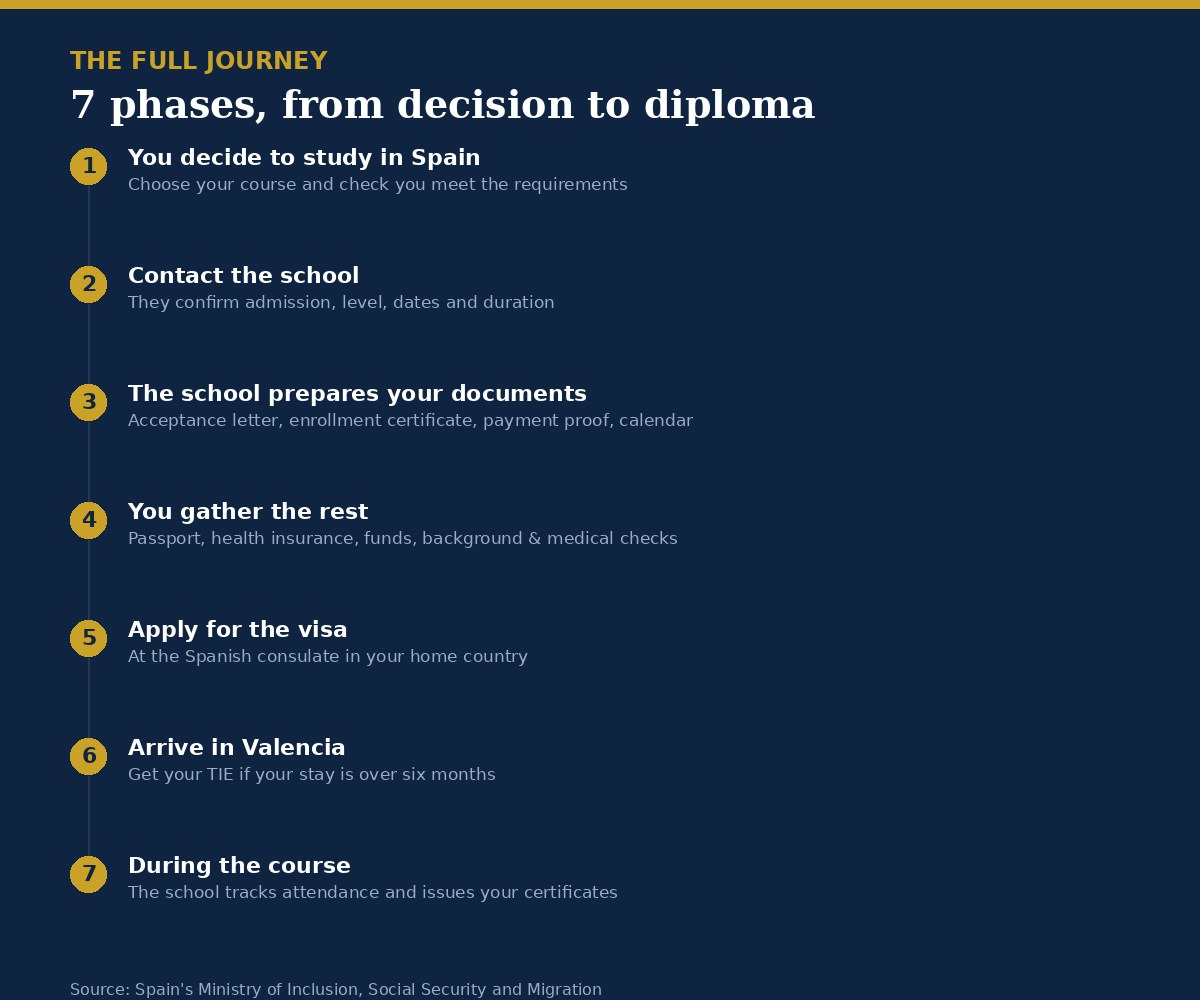
Most visa stress comes from treating this as one big, opaque task. Broken into seven phases, it becomes something you can actually manage: a decision, a conversation with a school, a set of documents produced for you, a set of documents you gather yourself, a submission, an arrival, and an ongoing responsibility during your course. Each phase has a clear owner — you, your school, or the consulate — and knowing who's responsible for what is most of the battle.
The phase most students underestimate is the third one: what your school produces. A disorganized school with slow or inconsistent paperwork can quietly derail phases four and five, no matter how well you've prepared your own documents. It's the reason we vet the schools we recommend specifically for how reliably they handle this part.
Let us guide you to the right start
From choosing your course to connecting with a school that will support you through the rest of the journey, we help international students take the first, most important steps toward their Spanish student visa.
Start your Valencia journey →Frequently asked questions
What are the main phases of the Spanish student visa process?
Seven: deciding to study in Spain, contacting the school, the school preparing your documents, you gathering your own documents, applying for the visa, arriving in Valencia, and the school's ongoing role during your course.
What documents does the school provide?
Typically an acceptance letter, an enrollment certificate, an invoice or proof of payment, a course calendar, and information about the school's accreditation where applicable.
What documents do I need to provide myself?
Your passport, health insurance, proof of sufficient financial means, and — when applicable, usually for longer stays — a criminal record certificate and a medical certificate.
Where do I apply for the visa?
Normally at the Spanish consulate in your home country. In specific cases, current regulations allow processing from within Spain if particular requirements are met, though this isn't the standard route for most language students.
Do I need a TIE when I arrive?
Only if your authorization is for more than six months. Shorter stays don't require one.
Does the school's role end once my visa is approved?
No. During your course, the school monitors your attendance, issues attendance and completion certificates, helps with renewal documentation if you continue studying, and reports significant course abandonment to the authorities when required.
What happens if I stop attending my course?
Since your visa is tied to genuine, ongoing enrollment, significant abandonment can be reported to the immigration authorities when regulations require it, which can affect your legal status.
How early should I start phase 1?
As early as possible — ideally several months before your intended start date, since document preparation, consulate appointments and processing all take time.
Can a disorganized school delay my visa?
Yes. Since the school produces core documents in phase 3, delays or errors on their end can hold up your entire application, even if your own paperwork is ready.
Is this process the same for every nationality?
The overall phases are the same, but specific requirements, fees and processing times vary by consulate and nationality. Always confirm current details with the consulate covering your area.
Ready to start phase one?
Fill in the form and we'll help you choose the right course and connect you with a school that will prepare your documents and support you through the rest of the process.
Get started →