
Student Visa vs Non-Lucrative Visa vs Digital Nomad Visa: Spain's Legal Paths Compared
Three visas, three completely different lives in Spain. One asks for a remote job paying well above average. One asks you to prove thousands in passive income and never work at all. And one — the one fewer people research properly — asks for a fraction of either, and just wants you enrolled in something real.
Key takeaways
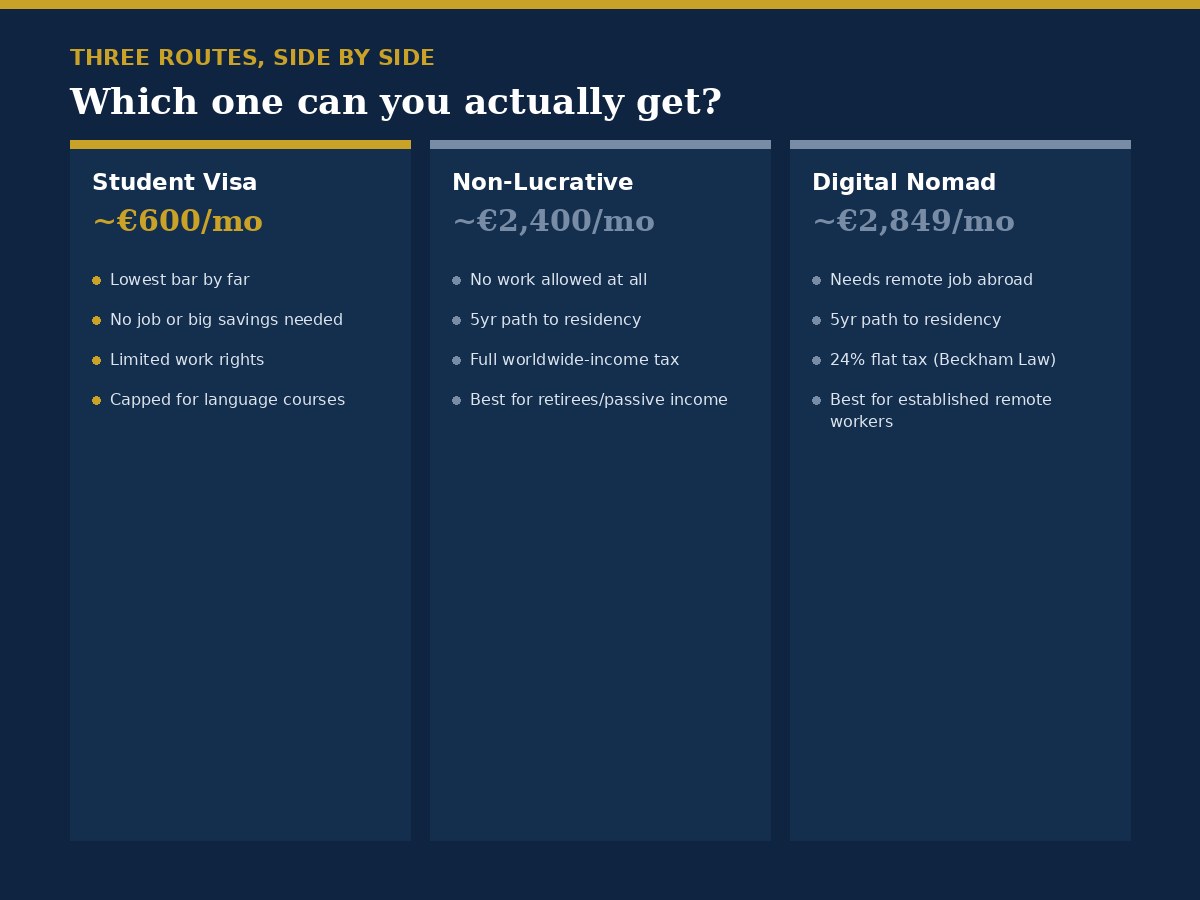
- The Non-Lucrative Visa (~€2,400/month) and Digital Nomad Visa (~€2,849/month) both require serious, provable income most applicants simply don't have yet.
- The student visa requires proving only around €600/month — roughly a quarter of either alternative.
- Both the NLV and DNV follow a five-year path to permanent residency; the student visa doesn't automatically build toward that, but it's the only route most people can realistically start right now.
- Each route suits a genuinely different life stage — this guide helps you see which one is actually yours, not just which one sounds best.
Search "how to move to Spain" long enough and these three visas keep coming up, usually compared in vague, surface-level lists that skip the number that actually decides things for most people: how much money you need to prove, and whether you already have it. This guide fixes that. We'll put all three side by side — income, work rights, taxes, timelines — and be honest about who each one is realistically for. If you want the fuller landscape first, our guide to how to move to Spain legally covers every route, including work visas and family reunification.
What this guide covers
The three routes, at a glance
Before the details, here's the shape of the decision:
Student Visa, in depth
Built for anyone enrolled full-time in a qualifying course — not just 18-year-olds fresh out of school. It's the route with by far the lowest financial threshold of the three.
- Who needs it: anyone who doesn't already have a remote job or sizeable savings, but wants to legally live in Spain now.
- Getting in: enroll in an accredited full-time course — an intensive Spanish course is the most common choice — get your acceptance letter, and apply at your local consulate.
- Work rights: generally up to 30 hours a week, though language-academy students usually need a separate authorization first. See our full guide to working on a student visa.
- The honest limit: language-course stays are capped in total renewable length, and this route doesn't convert directly into a work-and-residence permit the way higher-education study can.
Non-Lucrative Visa, in depth
Built for people who can support themselves without working in Spain at all — the classic route for retirees and financially independent applicants.
- Who needs it: people with substantial passive income (pensions, investments, rental income) and no intention of earning locally.
- Getting in: prove roughly €2,400/month (~€28,800/year) in passive income, plus health insurance and a clean record.
- Work rights: none — not even remote work for a foreign employer. This surprises people more than any other detail on this list.
- The upside: a clear 1+2+2-year path to permanent residency after five years, with a straightforward renewal process once established.
Digital Nomad Visa, in depth
Built for people already earning well from abroad who want to relocate without changing employers or clients.
- Who needs it: remote employees or freelancers with stable, well-documented income from outside Spain, comfortably above the threshold.
- Getting in: prove roughly €2,849/month (200% of Spain's minimum wage), with a detailed letter confirming your remote arrangement and your employer's non-Spanish base.
- Work rights: yes, for your foreign employer or clients — that's the entire point of the visa.
- The upside: access to the "Beckham Law" flat 24% tax rate on Spanish-sourced employment income for up to six years, plus a similar five-year path to permanent residency as the NLV.
If Spanish is part of your plan while you're on this route, our guide to Spanish courses for digital nomads in Valencia covers formats built around a full-time remote work schedule.
Full side-by-side comparison
| Student Visa | Non-Lucrative Visa | Digital Nomad Visa | |
|---|---|---|---|
| Monthly income needed | ~€600 | ~€2,400 | ~€2,849 |
| Income source required | None — course enrollment instead | Passive (pension, investments) | Active remote work from abroad |
| Can you work? | Up to 30h/week, conditions apply | No, not even remotely | Yes, for foreign employer/clients |
| Initial validity | 1 year (or course length if shorter) | 1 year | 1 year, then 3-year card |
| Renewal pattern | Annual, capped for language courses | 1+2+2 years | 1+3+2 years |
| Path to permanent residency | Not automatic for language courses | Yes, after 5 years | Yes, after 5 years |
| Minimum days in Spain/year | Not strictly enforced the same way | 183+ days required | 183+ days generally expected |
| Special tax regime | None specific | None — full tax residency | Beckham Law: flat 24% (up to 6 yrs) |
| Family members | Restricted, mainly higher education | Yes, with added income per person | Yes, with added income per person |
| Best suited to | Most people without savings/remote income | Retirees, passive investors | Established remote professionals |
Two patterns jump out. First, the NLV and DNV are mirror images of each other — one forbids all work, the other requires it — while the student visa sits in its own category entirely, needing neither a job nor a fortune. Second, the NLV and DNV both build toward permanent residency in a straight, well-worn line; the student visa's honest strength is different — it's not about the destination, it's about being the only door that's actually open today for most people.
Taxes: the part people skip
This deserves its own section because it changes the real cost of each route significantly:
- Non-Lucrative Visa: once you pass 183 days a year in Spain, you become a full tax resident, taxed on your worldwide income at standard Spanish rates — no special regime softens this.
- Digital Nomad Visa: many holders can opt into the Beckham Law, paying a flat 24% on Spanish-sourced employment income (up to €600,000/year) for up to six years, rather than full progressive worldwide taxation — a meaningful saving for higher earners.
- Student Visa: tax residency generally follows the same 183-day logic, but many students on shorter programs simply don't cross that line, and — without local employment income beyond limited part-time work — there's typically far less at stake tax-wise in the first place.
Which one is actually yours?
Strip away the marketing and it comes down to one honest self-assessment:
- Do you have €2,400+/month in passive income you don't need to touch for years? → The Non-Lucrative Visa is likely your route.
- Do you have a stable remote job or client base paying comfortably above €2,849/month? → The Digital Nomad Visa fits.
- Is the honest answer "no" to both? → For most people, the student visa is the only one of the three you can realistically start this year, not in some future version of your finances.
That's not a consolation prize. It's a legal, well-established route that gets you living in Spain full-time, today, at an income level a huge number of people can actually meet — while you build the language skills, local network and life experience that make the other two routes far more achievable down the line, from inside the country rather than from abroad.
See if the student route fits your numbers
Tell us your situation and we'll help you understand honestly whether the student visa is your fastest legal way into Spain, and match you with a qualifying course in Valencia — free, no obligation.
Get free guidance →The honest trade-off of the student route
To be fair to the other two: the NLV and DNV both offer something the student visa doesn't automatically — a clean, well-defined line to permanent residency. If you already qualify for either, that's a genuine advantage worth weighing.
What the student visa trades for its low bar is a narrower, more immediate purpose: real, full-time study. It isn't a backdoor, and treating it as one — enrolling without real intent to attend — risks both your visa and your renewal. Used honestly, though, it's exactly what it says: a legal way to spend a real chunk of your life in Spain, learning a language that opens the rest of the country up to you, while you decide what comes next. For many people, that's not a compromise — it's the actual best available option, not just the cheapest one.
Frequently asked questions
What's the easiest visa to get for Spain?
In terms of the income you need to prove, the student visa is the most accessible — around €600/month compared to roughly €2,400–2,849/month for the Non-Lucrative or Digital Nomad visas.
Can I work on a Non-Lucrative Visa?
No. The Non-Lucrative Visa prohibits all work, including remote work for a foreign employer. If you need to work, even remotely, the Digital Nomad Visa or a work visa is the appropriate route instead.
Can I work on a Digital Nomad Visa?
Yes, but only for employers or clients based outside Spain — that's the entire premise of the visa. Working for a Spanish company requires a different permit.
Do all three visas lead to permanent residency?
The Non-Lucrative and Digital Nomad visas both offer a five-year path to permanent residency. The student visa doesn't automatically build toward that for language courses, though higher-education study has more flexibility.
Which visa is cheaper in terms of taxes?
Digital Nomad Visa holders can often access the Beckham Law's flat 24% rate on Spanish-sourced income, while Non-Lucrative Visa holders are typically taxed on worldwide income at standard rates. Tax treatment is genuinely individual, so consult a tax advisor for your specific situation.
Can I switch from a Non-Lucrative Visa to a Digital Nomad Visa?
No — as of current rules, this direct modification isn't permitted. You would need to apply for the Digital Nomad Visa from your home country instead.
Is the student visa only for young people?
No. There's no upper age limit, and the student visa is used by career-changers, people between jobs, and anyone else who enrolls in a genuine full-time course, regardless of age.
How much do I need to earn for the Digital Nomad Visa?
Roughly €2,849 a month, based on 200% of Spain's minimum wage, with additional amounts required for a spouse or dependents.
How much passive income do I need for the Non-Lucrative Visa?
Roughly €2,400 a month (around €28,800 a year) for a single applicant, plus additional amounts for accompanying family members.
Which visa is best if I don't have much money saved?
The student visa, by a wide margin. Its financial threshold is roughly a quarter of the Non-Lucrative or Digital Nomad visa requirements.
Do I need to spend a minimum number of days in Spain on each visa?
The Non-Lucrative and Digital Nomad visas generally require 183+ days per year in Spain to maintain and renew status. The student visa doesn't enforce this in quite the same way, though genuine attendance at your course is expected.
Can I bring my family on any of these visas?
Family members can generally accompany Non-Lucrative and Digital Nomad Visa holders, with extra income required per person. Family reunification on a student visa is more restricted, mainly available for higher-education students.
Is the student visa a legitimate long-term strategy?
It's a legitimate, legal way to live in Spain now, but it isn't designed as a long-term residency strategy on its own — language-course stays are capped, and it doesn't convert directly into work-and-residence status. Many people use it as a stepping stone while building toward a different long-term route.
What happens if my income drops below the threshold after I'm approved?
For the Non-Lucrative and Digital Nomad visas, failing to maintain the required income can jeopardize renewal. The student visa's requirement is generally assessed at application rather than continuously monitored in the same way, though genuine course attendance remains essential.
Ready to explore the student route?
Fill in the form and we'll help you understand your options honestly, and match you with a qualifying Spanish course in Valencia if it fits — free and with no obligation.
Get started →