
Your 90 Days in Spain Are Up. Now What?
You came for a couple of weeks. Now your 90 days are ticking down, and Valencia has quietly become somewhere you don't want to leave. Good news: you have more real options than most people realize — some strong, some narrow, one that doesn't actually work at all. Here they all are, ranked honestly.
Key takeaways
- There are five real paths once your 90 days run out — and one common idea (overstaying) that isn't a path at all.
- For most people without significant savings or high remote income, enrolling in a course and applying for a student visa from home is by far the most accessible option.
- The Non-Lucrative and Digital Nomad visas work well if you qualify financially, but need €2,400–2,849/month.
- You can start the strongest option today, while you're still in Valencia — enrolling now means your paperwork is ready the moment you're home.
Here's the honest starting point: you cannot simply convert your tourist status into something longer-term from inside Spain — that door closed for language students with the 2025 immigration reform. But that's really just one wrong turn to rule out, not the end of the road. There are several genuine ways to make a longer life in Spain happen. Let's go through all of them, so you can pick the one that's actually yours.
What this guide covers
- Your five real options, at a glance
- Option 1: Enroll, go home, apply for a student visa
- Option 2: Non-Lucrative or Digital Nomad Visa
- Option 3: Family reunification
- Option 4: Travel to a nearby non-Schengen country
- Option 5: Accept it was a visit, plan a proper return
- Why overstaying isn't a real option
- Which one is actually yours?
- FAQ
Your five real options, at a glance
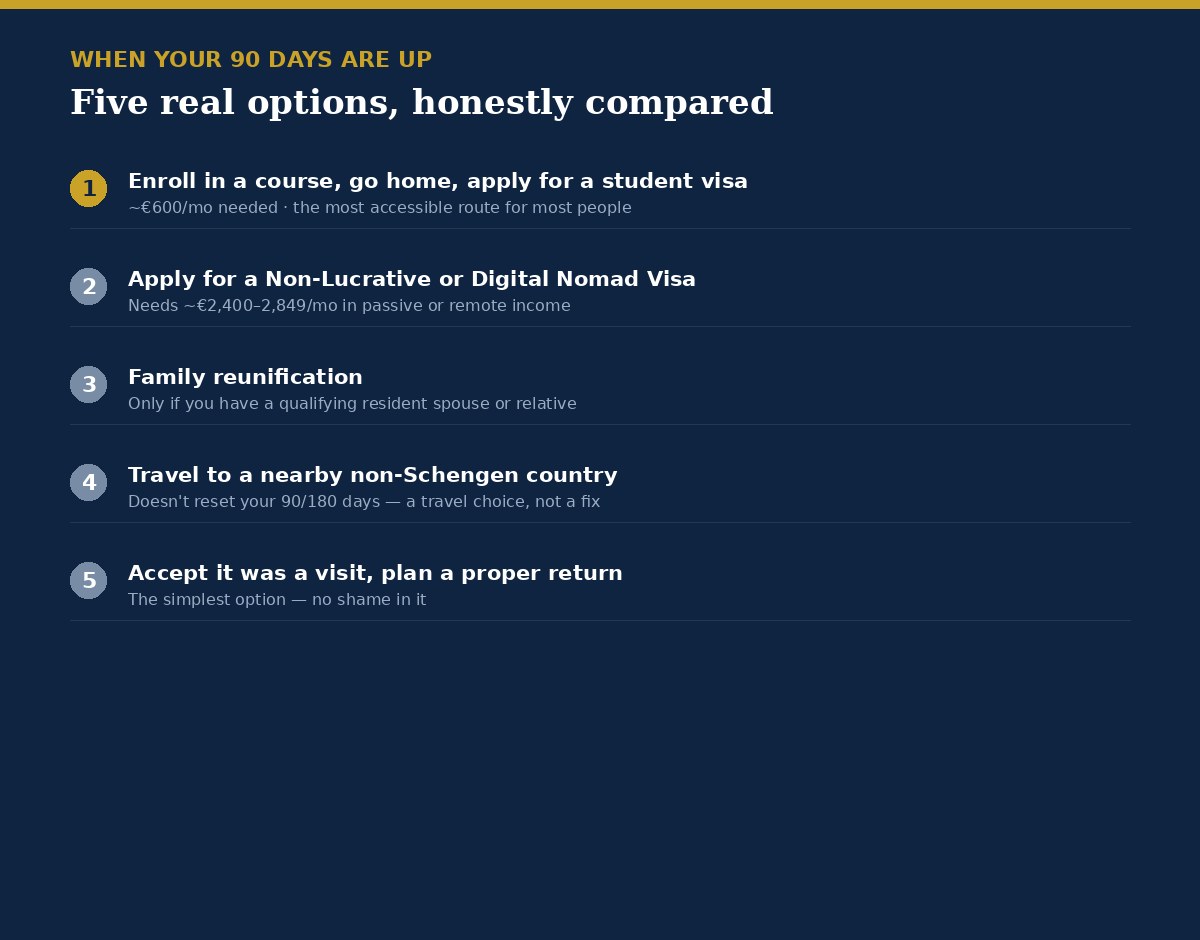
Before the details, here's the honest shape of the decision:
Option 1: Enroll in a course, go home, apply for a student visa
For most people reading this, this is the option that actually fits. It requires proving only around €600 a month — a fraction of the alternatives below — and doesn't need a job offer, a qualifying relative, or years of savings. It just needs a real course and a bit of patience while the paperwork catches up with your enthusiasm.
Here's exactly how it works, step by step:
Choose your course and enroll now, while you're still here
Pick an accredited intensive Spanish course in Valencia, enroll, and get your acceptance letter — all while you're still physically here and can ask questions, visit the school, and know exactly what you're signing up for.
Fly home before your 90 days are up
Leave in good standing, with no fines and no black mark on your travel record. This keeps every future application — this one and any other — completely clean.
Apply at your local Spanish consulate
With your acceptance letter and enrollment already sorted, this step moves fast — you're not starting from scratch, you're finishing something you already began in Valencia. Our step-by-step visa process guide covers every phase in detail.
Fly back — this time properly, and for longer
You return to Valencia on a real long-term student visa, ready to pick up exactly where your trip left off, minus the ticking clock.
Start it today, while you're still here
Enroll in an accredited intensive Spanish course in Valencia now.
Enroll before you fly home →Option 2: Non-Lucrative Visa or Digital Nomad Visa
If your finances genuinely support it, these are real residence routes, not stays — meaning they build toward permanent residency in a way the student route doesn't automatically. The catch is the threshold: the Non-Lucrative Visa needs around €2,400/month in passive income and forbids all work, while the Digital Nomad Visa needs around €2,849/month in verified remote income. Both also require applying from outside Spain, so the "leave and apply" logic is the same as Option 1 — just with a much higher financial bar to clear first.
For a full, honest comparison of all three routes — income needed, work rights, taxes, and who each one really suits — see our guide to Student Visa vs Non-Lucrative vs Digital Nomad Visa.
Option 3: Family reunification
If you have a spouse, partner or close family member who's a legal resident of Spain, this may be available to you. It's a genuine route, but a narrow one — it depends entirely on having that qualifying relationship already, which most tourists reading this simply don't have. If it applies to you, it's worth exploring directly with an immigration professional, since the requirements vary by relationship and by your family member's own status.
Option 4: Travel to a nearby non-Schengen country
Some people consider hopping to Morocco, the UK, or another non-Schengen country nearby, planning to wait it out or apply from there. Let's be precise about what this does and doesn't do: it does not reset your 90/180-day Schengen count — that clock is cumulative across the whole Schengen Area and doesn't restart just because you left. What it can do is give you a base outside Schengen while you handle logistics or wait for an appointment, or apply at a Spanish consulate in that country if you have legal residence there. For most tourists, though, it's a detour, not a shortcut — the actual application still needs to happen through your home country's consulate in the vast majority of cases.
Option 5: Accept it was a visit, plan a proper return
Sometimes the honest, low-drama answer is the right one: treat this trip as the one that showed you what you want, go home on schedule, and come back properly when the timing and paperwork are right — whether that's in a month or a year. There's no shame in this option, and it keeps everything clean for whenever you are ready to do Option 1 for real.
Why overstaying isn't a real option
One idea deserves to be ruled out clearly, because it isn't actually an option at all: staying past your 90 days and hoping it goes unnoticed. As of 2026, the Schengen Area's entry and exit system is fully digital — every crossing is automatically logged, with no grace period. Overstaying can lead to fines and entry bans that keep you out of the entire Schengen Area for months or years, and it creates a record that can complicate visa applications well beyond Europe — including the very student visa you might apply for under Option 1.
Which one is actually yours?
Strip it down to one honest question: do you already have €2,400+ a month in passive income, or a stable remote job paying well above €2,849 a month? If yes, Option 2 is worth pursuing seriously. Do you have a spouse or close family member legally resident in Spain? Option 3 might apply. For genuinely everyone else — which, realistically, is most people reading this — Option 1 is the one you can actually start today, at an income level far more people can meet, without waiting for your finances or your relationship status to change first.
Don't let your 90 days be the end of the story
Fill in the form and we'll help you enroll in a course today, so your visa application is ready to go the moment you're home. Free and with no obligation.
Get started →Frequently asked questions
What are my options when my 90 days in Spain are up?
Five real paths: enroll in a course and apply for a student visa from home, apply for a Non-Lucrative or Digital Nomad Visa if you qualify financially, pursue family reunification if you have a qualifying relative, travel to a nearby non-Schengen country as a logistics base, or simply leave and plan a proper return later. Overstaying is not a real option.
Can I convert my tourist stay into a student visa while I'm in Spain?
No, not for a language-academy course. Since Spain's 2025 immigration reform, this must be applied for at a Spanish consulate in your home country, not from inside Spain.
What's the most accessible option for most people?
The student visa route. It requires proving only around €600/month, compared to roughly €2,400–2,849/month for the Non-Lucrative or Digital Nomad visas, and doesn't require a job offer or qualifying family relationship.
Does leaving for a non-Schengen country reset my 90 days?
No. The 90-day allowance is calculated on a rolling 180-day basis across the entire Schengen Area, and it isn't reset by a trip to a nearby non-Schengen country.
What happens if I just stay past my 90 days?
The Schengen Area's digital entry and exit system automatically tracks overstays as of 2026. Consequences can include fines and entry bans affecting future travel across the entire Schengen Area, plus complications for future visa applications.
Can I qualify for the Non-Lucrative or Digital Nomad Visa?
Only if you can prove roughly €2,400/month in passive income (Non-Lucrative) or €2,849/month in stable remote income (Digital Nomad). Both also require applying from outside Spain.
What is family reunification and does it apply to me?
It's a route for people with a spouse, partner or close family member who is a legal resident of Spain. It only applies if you already have that qualifying relationship.
Can I enroll in a course before I leave Spain?
Yes, and it's the smartest move for Option 1 — enrolling now means your acceptance letter and paperwork are ready the moment you're home, which speeds up your visa application significantly.
How long does the student visa process take?
Typically one to three months after you apply, so the sooner you enroll and start the consulate process once home, the sooner you're back in Valencia.
Is it common for tourists to come back this way?
Yes, very. Many long-term students in Valencia started exactly this way — a short trip, a decision to come back properly, and a student visa arranged from home.